
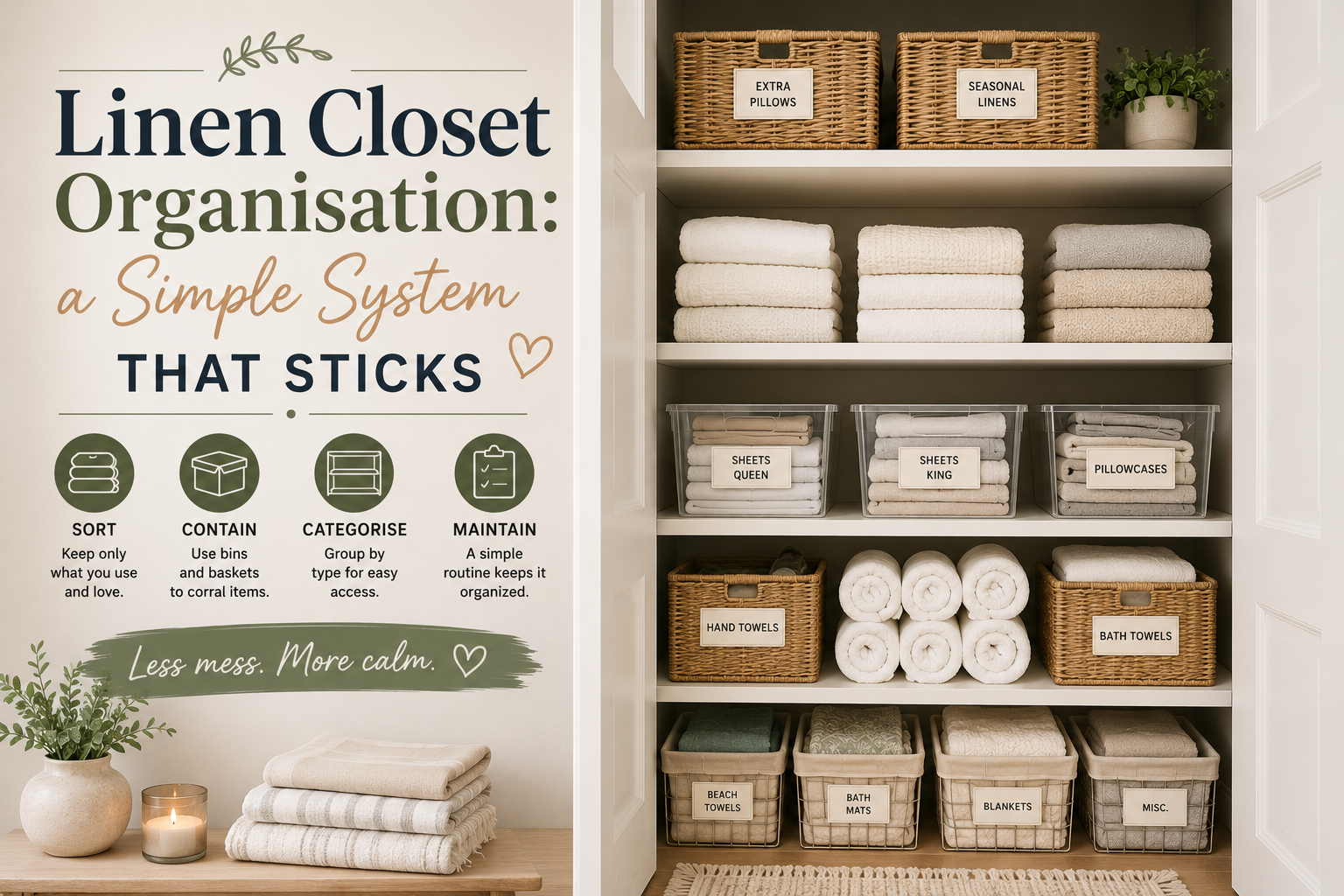
If you open your linen closet and immediately feel overwhelmed by mismatched sheets, tangled towels, and stacks that topple the moment you pull something out, you are not alone. The linen closet is one of the most-used storage spaces in the home, yet it is often the last one to get any real organization. The good news is that fixing it does not require a full renovation or expensive custom shelving. With one simple, repeatable system, you can turn a chaotic closet into a calm, functional space that stays tidy long after the initial cleanup.
Why a System Beats a One-Time Cleanup
Most people have refolded their linen closet at least once, only to watch it fall back into chaos within a few weeks. That happens because a one-time cleanup treats the symptom, not the cause. Without a system for how items go back, family members default to shoving folded towels wherever there is space, and the same tangle returns before long. A real system gives every item a designated home, so putting things away correctly becomes just as easy as tossing them onto a shelf. The four steps below follow the same sort, contain, categorize, and maintain approach professional organizers use in any small space, and they work just as well in a hallway linen closet as they do in a walk-in pantry.
Step One: Sort — Keep Only What You Use and Love
Before you buy a single bin, pull everything out of the closet and sort it into three simple piles: keep, donate, and toss. Linen closets tend to accumulate scratchy old towels kept just in case, mismatched pillowcases, and sheet sets missing their fitted sheet. If a towel is frayed beyond a quick trim, or a blanket has not been unfolded in over a year, it is taking up space your daily-use items actually need. A good rule of thumb is to keep two to three sets of sheets per bed and enough towels for each household member plus a couple of spares, then pass the rest along to a local shelter or textile recycling program.
Step Two: Contain — Corral Items With Bins and Baskets
Once you know what is staying, group loose items into bins or baskets so they cannot slide around or topple every time you open the door. Woven baskets work well for bulkier items like extra pillows or seasonal blankets, while clear bins suit smaller items such as folded pillowcases, since you can see the contents without lifting a lid. Containing items this way also protects your shelves and creates flexible units you can pull out entirely when you need to grab something in a hurry. In a closet with deep or awkward shelving, a shallow bin near the front and a taller basket toward the back can put the full depth of the shelf to use instead of wasting it.
Step Three: Categorize — Group by Type for Easy Access
With everything contained, group the bins and baskets by category rather than by size or color. Keep bed sheets sorted by size, such as queen and king, in separate containers, store all bath towels together, and keep hand towels and washcloths apart from bath mats and beach towels. Labeling each bin or basket, even with a simple handwritten tag, means anyone in the household can find what they need and put it back in the right spot without guessing. Placing the items you reach for most, like everyday sheet sets and bath towels, at eye level, while reserving the top and bottom shelves for seasonal or rarely used linens, keeps the whole system intuitive to use.
Step Four: Maintain — A Simple Routine Keeps It Organized
A system only sticks if it is easy to maintain. Set a quick five-minute reset at the end of each week to refold anything that got tossed in during a busy morning, and do a deeper seasonal check twice a year to reassess what still earns its spot. Every time you bring home a new set of sheets or towels, let an old set go, so the closet never creeps back toward overflowing. Because everything already has a labeled, contained home, maintaining the system takes minutes rather than the hours a full reorganization once required.
A Few Tools That Make It Easier
A handful of simple supplies make this system much easier to set up: sturdy woven baskets for bulky items, clear stackable bins for smaller ones, and a basic label maker or a set of adhesive labels so every container is easy to identify at a glance. We keep an updated list of the storage bins, labels, and organizers we personally recommend, if you would like a head start on supplies.
The Bottom Line
A linen closet does not need to look picture-perfect to work well, it just needs a system that everyone in the household can follow without thinking twice. Sort out what you no longer need, contain what is left, categorize it by type, and build in a small habit of maintenance, and your linen closet can stay calm and functional long after the novelty of the initial cleanup wears off.